 Drew · 10
"Mom, I'm really sad for those kids. Did you hear what their parents were saying to them?"
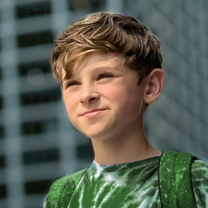
Drew, my ten-year-old, walked out of the Smithsonian's National Air and Space Museum makerspace clutching his flight design. I expected lightness in his step. He'd just set the record on the aerodynamics challenge (build a craft that stays aloft in the upward wind tunnel as long as possible), but he was focused on another challenge he saw.
"They asked their daughter what she was making. She said she didn't know, so her parents said there's no point making something if you don't know what it is. Then they told her how she should make it.
I felt so bad for her. There is a point to making something you don't know yet." He threw his hands up in the air and shrugged them back down as he emphasized, "They didn't let her experiment, so how would she ever know what to build?"
He was upset. I was dumbfounded.
I thought back to just a few moments ago, when I'd considered stepping in on what Drew was building. Everyone else was making some variation of a parachute. Drew took off his parachute from his first iteration and was building something completely foreign. It was uneven. There's no way that'll work.
I wanted so badly to suggest a different design. I paused. A little voice in my head said, "Just let him." So I did. He put it in the wind tunnel and it flipped over and fell.
He went back to the table and stared at it. He traced his fingers across it, feeling out the airflow. More staring.
Then, "Oh! I know!" As he leapt out of his seat, everyone in the room looked at him, startled. His eyes scanned the materials and his hands jetted out to grab a pipe cleaner and another paper. Cut. Poke. Wrap. Tape. Fiddle. Retape. If it were possible, it looked weirder.
He ran up to the wind tunnel. Handed it to the volunteer. It started to float up, started to tilt, then… tilted back, and stabilized. Then it just… floated there, with only gentle moves back and forth, up and down. It stayed. The volunteer looked at the stopwatch. "Wow! That's the max time!" Drew jumped up and down. "Wow, Drew! That's amazing!" I said in disbelief.
Another minute passed. The volunteer looked at the stopwatch again. Then, again. Again. And again, but less enthusiastically each time. A line started to form for turns but Drew's just kept floating. "Ok. We have to give other kids a turn now. Good job." She handed it back.
I asked him how he'd figured it out. He walked me through it: how the shape let air spill around, how the funnel at the top stabilized it.
You guys. I almost told him to do something else. I almost discouraged him from the process that led to success.
He didn't succeed because someone taught him how to build it. And he didn't succeed just because I stayed quiet that day.
Before roamschool, Drew spent years in classrooms shaped by the same instinct as those parents at the museum: keep moving, get to the right answer, don't linger too long in confusion or curiosity. The learning environment was designed to prioritize coverage over where his greatest potential was.
I've let him fail, over and over, inside an environment built for it: real materials, real constraints, real feedback, and a parent who stays quiet on purpose. That combination, not failure alone, is what let him notice the opportunity the other kid never got.
Kids don't want to be handed the answers. They want better questions, and the sense of playfulness, pride, and purpose that comes from finding it themselves.
It's not nice to have. It's a need to have. Without it, they learn to do what people tell them to do. With it, they learn to learn, learn to believe, learn to think, and learn to solve problems. They learn how to make a difference.
While I'm incredibly proud of Drew for what he accomplished with knowledge and skills he built himself, what I'm most proud of is what he noticed and continues to teach me every day:
When you want to teach, don't teach. Give them what they need to teach themselves.